
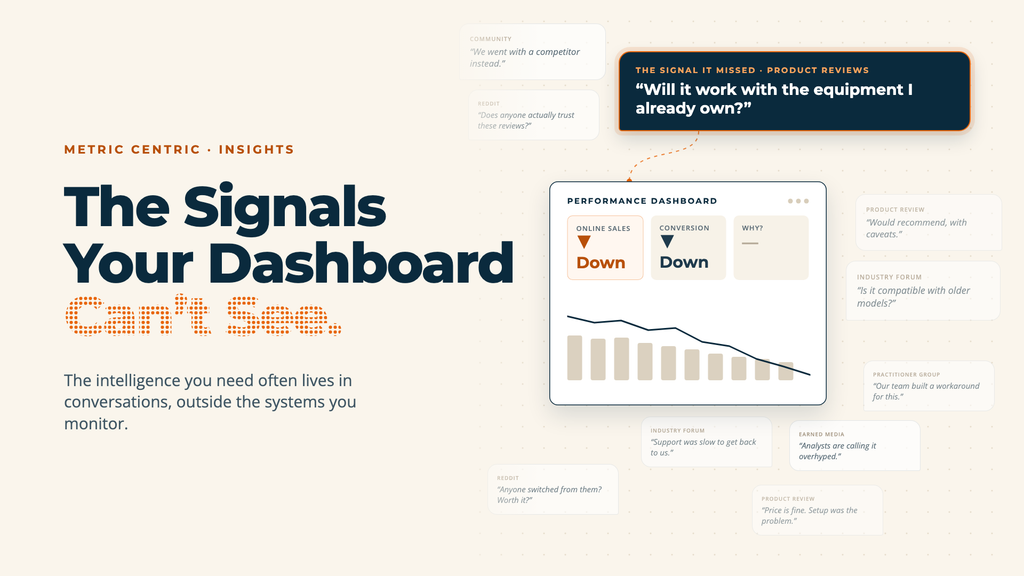
Some of the most valuable business intelligence isn’t found in dashboards or traditional research. It’s hidden in conversations across social media, online communities, customer reviews, industry forums, and earned media – revealing what audiences think, trust, question, and value.
By George Assimakopoulos
Founder & Managing Principal, Metric Centric
Businesses have never had more data at their fingertips.
Executives can track website traffic, customer acquisition costs, sales performance, conversion rates, social engagement, and countless other metrics through increasingly sophisticated dashboards. Artificial intelligence has made these systems faster and better at identifying patterns across enormous datasets.
Yet organizations still struggle to answer some of their most important questions.
- Why are prospective customers choosing a competitor?
- What concerns emerge before they appear in sales performance?
- Which industry conversations are reshaping perceptions of our brand?
- What do people actually believe about the value we deliver?
- What is happening in the marketplace that we haven’t thought to measure?
There is a critical distinction at the heart of these questions: the difference between what people do and what they believe.
Performance data can show that a prospect abandoned a purchase, a customer didn’t renew, or a product is losing market share. It may not explain why.
Consider a company experiencing declining online sales. Its dashboard identifies the problem, but conversations across customer forums and product reviews reveal that buyers aren’t necessarily concerned about price. They’re questioning whether the product will work with equipment they already own.
That discovery changes the question the company needs to ask – and potentially the solution it pursues.
The problem businesses face isn’t necessarily a lack of data. It’s that much of the intelligence they need exists outside the systems they’re accustomed to monitoring.
It lives in conversations.
Marketplace conversations can reveal questions organizations never thought to ask. When people talk freely about their needs, frustrations, and workarounds, they may expose opportunities that no survey, dashboard, or research brief was designed to capture.
The Blind Spot in Traditional Business Intelligence
Traditional business intelligence is exceptionally good at telling organizations what has happened.
- Sales dashboards show revenue trends.
- CRM platforms track pipeline activity.
- Web analytics reveal how visitors interact with digital properties.
- Customer satisfaction surveys capture feedback from people willing to participate.
These are essential sources of intelligence. But they largely measure activity within environments organizations already know to observe, using questions and categories they’ve already defined.
Meanwhile, another stream of marketplace intelligence is developing across the open web.
- Prospective customers compare products in Reddit discussions.
- Industry professionals debate technologies in specialized forums.
- Buyers express frustrations in online reviews.
- Practitioners exchange recommendations within professional communities.
- Journalists and analysts shape perceptions through earned media.
These conversations often reveal what people think, question, trust, resist, and recommend without any direct interaction with the brands being discussed.
These signals don’t arrive neatly organized into rows, columns, or predefined reporting categories. They are fragmented, contextual, emotional, and frequently ambiguous.
And that’s precisely what makes them valuable.
A dashboard may show that demand is declining. Conversations may explain why, reveal shifting perceptions, and expose warning signs before the decline becomes obvious.
From Digital Noise to Marketplace Intelligence
The challenge, of course, is scale.
Millions of conversations unfold across digital channels every day. No research team can manually read and interpret every discussion relevant to a brand, industry, or emerging business issue.
This is where artificial intelligence fundamentally changes the equation.
Natural language processing (NLP) and machine learning make it possible to:
- Analyze large volumes of unstructured conversational data.
- Identify recurring themes and relationships between topics.
- Recognize emerging trends and shifts in audience priorities.
- Assess sentiment and surface patterns that might otherwise remain hidden.
But identifying patterns is not the same as understanding their business significance.
A spike in negative sentiment, for example, might reflect genuine dissatisfaction with a product. It also might result from a controversial news story, an unrelated political debate, sarcasm, or a small number of highly amplified conversations.
Similarly, a competitor generating significantly more mentions isn’t necessarily outperforming your brand. The conversation could reflect customer complaints, regulatory scrutiny, or reputational challenges.
AI can identify the signal. Human intelligence determines what the signal means.
Why Human Interpretation Still Matters
AI’s greatest value isn’t replacing human judgment, but expanding what informed human judgment can accomplish.
Analysts investigate underlying conversations, validate patterns, challenge assumptions, evaluate alternative explanations, and translate findings into business implications.
Human intelligence isn’t a final layer of interpretation. It’s central throughout the process: defining the right questions, assessing evidence, recognizing what AI may miss, and determining which findings deserve attention.
Consider three examples:
1. A university evaluating its competitive position.
Enrollment data reveals that fewer admitted students are choosing to attend. The university assumes tuition is the problem and considers increasing financial aid.
But conversations among prospective students reveal other concerns:
- Whether programs provide practical experience.
- Whether students can work while completing their degrees.
- Whether career outcomes justify the investment.
These insights could reshape recruitment messaging, program positioning, or further research into prospective students’ needs.
2. An industrial manufacturer assessing market opportunities.
Sales data shows relatively flat demand. Meanwhile, engineers and contractors are discussing recurring frustrations with existing products, particularly difficulties integrating them into older systems.
Those conversations could point toward an unmet need: better compatibility or simpler installation.
A human would need to establish whether the issue is widespread and commercially relevant. If validated, the discovery could inform product development or reveal an opportunity competitors have overlooked.
3. A B2B media organization understanding its audience.
Website analytics show that articles about artificial intelligence generate significant traffic. The organization responds by commissioning more AI coverage.
But conversations across professional communities reveal that readers want less general commentary and more practical guidance on implementation costs, privacy, and demonstrating return on investment.
That discovery could reshape its editorial strategy, helping the organization answer questions its existing metrics don’t reveal.
In each of these cases, structured data tells part of the story. Conversational intelligence adds context and can uncover questions the organization didn’t know to ask. Human intelligence connects those discoveries to the decisions and business implications that matter.
The Signals Worth Listening For
Not every online mention represents meaningful business intelligence. The objective isn’t simply to collect more data; it’s to recognize the signals that can influence decisions.
Some of the most valuable include:
- Emerging needs and unmet expectations: What audiences are asking for, struggling with, or unable to find.
- Competitive positioning: How customers and practitioners compare brands in their own words.
- Reputation and trust: Which experiences, narratives, and third-party voices strengthen or weaken credibility.
- Purchase barriers: The objections, uncertainties, and perceived risks that influence decisions.
- Changing audience behavior: Where communities are gathering, which information sources they trust, and how their priorities are evolving.
- Early indicators of market change: New terminology, recurring frustrations, emerging technologies, or shifts in professional opinion.
These signals become more useful when analyzed together rather than treated as isolated mentions or sentiment scores.
The objective is to understand not just what people are saying, but who is saying it, why it matters, and what it suggests about the marketplace.
A compelling anecdote isn’t necessarily a meaningful trend. A single frustrated customer may raise a valuable question but does not necessarily determine whether the concern is recurring, representative, and relevant to business decisions.
The goal isn’t to confirm what leadership already believes. It’s to understand the market more clearly – even when the evidence challenges existing assumptions.
A New Dimension: What AI Is Saying About Your Brand
The way people discover and evaluate organizations is changing.
Consumers and business professionals increasingly turn to AI-powered answer engines –including ChatGPT, Gemini, Perplexity, Claude, and Google AI Overviews – to research products, compare providers, and inform purchasing decisions.
These systems don’t simply return lists of websites. They synthesize information into answers, drawing upon sources they consider relevant and authoritative.
That creates another dimension of brand visibility.
It’s no longer enough to understand what people are saying about your organization across the open web. You also need to understand what AI systems are saying about you, which sources they rely upon, and whether your brand is represented accurately when important questions are asked.
Conversational data analytics helps organizations understand the marketplace narrative: what audiences believe, discuss, and value.
Answer engine visibility analysis helps organizations understand how that narrative, along with other digital sources, is being interpreted and presented by AI answer engines.
The Future of Intelligence Is Not Another Dashboard
Dashboards will remain essential. Organizations need reliable performance measures, operational visibility, and clear ways to monitor results.
But the next competitive advantage won’t necessarily come from adding more metrics to an already crowded screen. It will come from connecting what organizations can measure with what their markets are actually expressing.
That requires a broader definition of business intelligence – one that includes structured performance data, unstructured marketplace conversations, AI-generated brand representation, and the human expertise needed to interpret the relationships among them.
The goal is not simply to know more. It’s to recognize opportunities earlier, understand risks more clearly, challenge assumptions, and make better-informed decisions.
That’s the thinking behind how you approach AI + Human Intelligence:
- AI gives us the ability to listen at scale.
- Human intelligence gives that listening context, meaning, and direction.
Together, they help organizations see beyond the numbers and understand the marketplace forces shaping them.
Because some of the most important signals influencing your business may never appear on your dashboard – unless you know where, and how, to listen.
What signals might your dashboard be missing? Connect with us at Metric Centric or share your thoughts in the comments. We’d love to hear your perspective.