
Michael B. Snead
Business Advisor @ Metric Centric
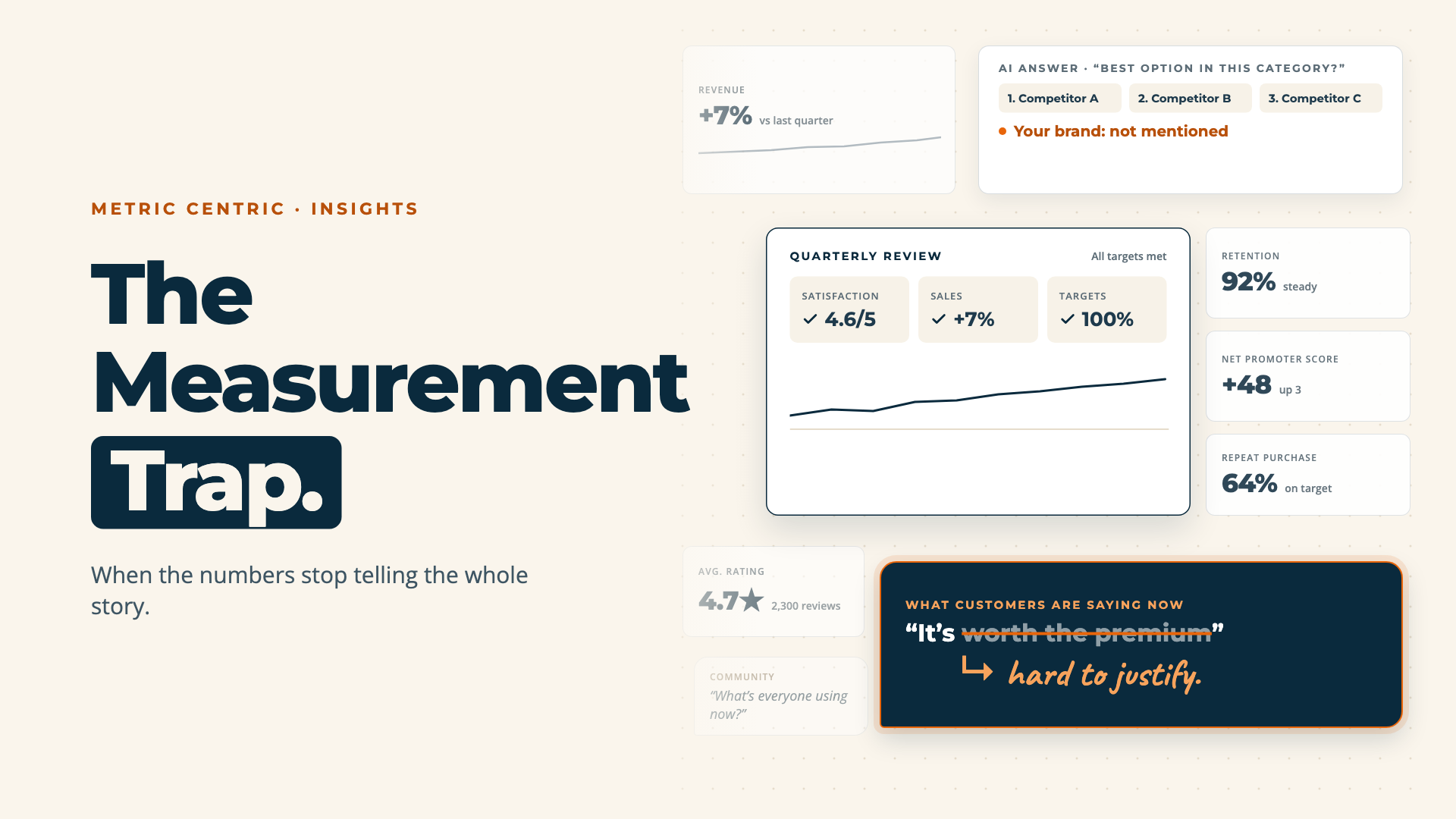
A business can be hitting its targets, keeping customers satisfied, and reporting healthy sales while quietly losing ground in the market.
The warning signs may already be there – in conversations its dashboards don’t capture and AI-generated recommendations that consistently point potential customers toward competitors.
The problem isn’t necessarily a lack of data. It’s that businesses often aren’t looking at the right kinds of information.
Business loves a good number. Numbers fit neatly into dashboards. They make quarterly reviews easier. They give leaders something concrete to point to when someone asks, “How are we doing?”
The trouble begins when the things we can easily measure become a proxy for everything that matters.
We measure what’s available, then gradually treat it as everything we need to know.
That’s the measurement trap: believing we’re seeing the whole picture because the numbers we’re tracking look good.
When Customer Language Changes
Consider a hypothetical company whose customer satisfaction score has barely changed. Sales are healthy, and the latest quarterly review offers little reason for concern.
But outside the company’s own channels, something is shifting.
In online communities, customers who once described its product as “worth the premium” are beginning to call it “hard to justify.” They still like the product. Increasingly, though, when someone asks what to buy, they’re recommending a cheaper alternative.
The satisfaction score has not moved. The conversation about value has.
That shift deserves investigation. Are customers reacting to a recent price increase? Has a competitor improved its offering? Is this a concern among a handful of vocal customers, or does it appear across independent communities?
The answers could influence pricing, product decisions, or how the company explains its value. Waiting for the concern to appear in retention figures could mean waiting until customers have already made their choice.
The missing information is not necessarily impossible to measure. Customer perceptions, recurring concerns, and changes in language can all be examined systematically.
They simply may be absent from the reports leadership routinely sees.
The AI Visibility Gap
There’s another layer to this problem: what happens when potential customers turn to AI for advice.
Imagine that same company has a strong customer base and generally positive online reviews. But when someone asks ChatGPT or another AI answer engine to recommend the best product in its category, the company rarely appears.
Instead, competitors dominate the recommendations.
That creates an important disconnect. The company may have earned a good reputation among people who already know it, but it isn’t necessarily part of the conversation when new customers are deciding what to buy.
And the consequences can extend beyond a missed recommendation. If potential customers repeatedly receive answers that favor competitors, those competitors may gain consideration and credibility before a salesperson ever has a chance to make a pitch. The company could lose future opportunities without seeing an obvious warning in its existing sales reports.
This is where AI can reinforce the measurement blind spot.
Give AI the same limited set of dashboard data, and it can produce a polished explanation of performance. The analysis may be accurate within those boundaries. Its apparent completeness can still make it easy to overlook what was never included.
We end up answering familiar questions faster while leaving important questions unasked.
Looking Beyond Our Own Channels
The opportunity is to widen the evidence we consider.
That includes conversations happening beyond our own websites, surveys, and social accounts, where people describe their experiences without being prompted by our questions. It also means examining how AI answer engines represent our brands and competitors.
What are customers questioning in communities our team rarely visits? Which competitor claims are gaining credibility? What language are people using when they compare products? How do AI answer engines describe our category, and which companies do they recommend?
These questions reveal different parts of the market.
Customer conversations can expose changing expectations, frustrations, and perceptions of value. AI-generated recommendations can show how a brand is presented to people seeking advice. Examining them together can help identify where a company’s market reputation and its visibility differ.
That gap is also an opportunity.
If a company understands why customers value its product but discovers that AI tools aren’t reflecting those strengths, it has something concrete to work on. It can improve the information available about its products, address gaps in its online presence, strengthen credible third-party coverage, and make its differentiators easier for both people and AI systems to understand.
In other words, the same information that reveals a competitive weakness can point toward a way to strengthen its position.
Using Judgment to Recognize Meaningful Change
Of course, a few comments don’t establish a trend. AI-generated summaries need checking, and online conversations require context. We need to examine who is speaking, whether a concern recurs, and how well the evidence relates to the audience we serve.
That is where judgment matters. It helps us decide which signals deserve attention and what further investigation would justify action.
These signals cannot reliably predict next quarter’s revenue. They can, however, reveal pressures and opportunities before their effects become visible in financial results.
Metrics remain essential. Their value grows when we connect them with evidence that helps explain what customers are experiencing and how their expectations are changing.
For leaders, a useful addition to the next performance review is a simple question: What might be changing that these numbers would not show us?
Recognizing change early gives a team time to investigate, test a response, and make a better decision. By the time a shift appears in revenue or retention, the available options may already be narrower.
And sometimes the most valuable intelligence isn’t another number on the dashboard. It’s discovering what the dashboard has been missing.
The New Intelligence Gap is a series from Metric Centric exploring why access to more data and increasingly powerful AI doesn’t automatically produce better business intelligence –and what organizations can do to close that gap.
At Metric Centric, we combine conversational data analytics, competitive intelligence, and Answer Engine Optimization (AEO) visibility analysis with experienced human interpretation. Our goal is to help organizations move beyond simply collecting data to learn what matters and why. If you’re interested in understanding what your markets are saying – and what AI is telling your audiences – let’s start a conversation.