
By Michael B. Snead
Business Advisor @ Metric Centric
Imagine a company that manufactures smart home security cameras. Over the past month, customer complaints about cameras unexpectedly disconnecting from Wi-Fi have started climbing.
An AI platform analyzes thousands of customer reviews, support tickets, Reddit discussions, and online forums. It identifies a growing pattern: customers are frustrated that their cameras are losing connection, sometimes leaving their homes without reliable security coverage.
So, what should the company do?
Should it pull engineers away from an upcoming product launch to investigate the complaints? Invest in improving customer support? Or wait to see whether the complaints fade?
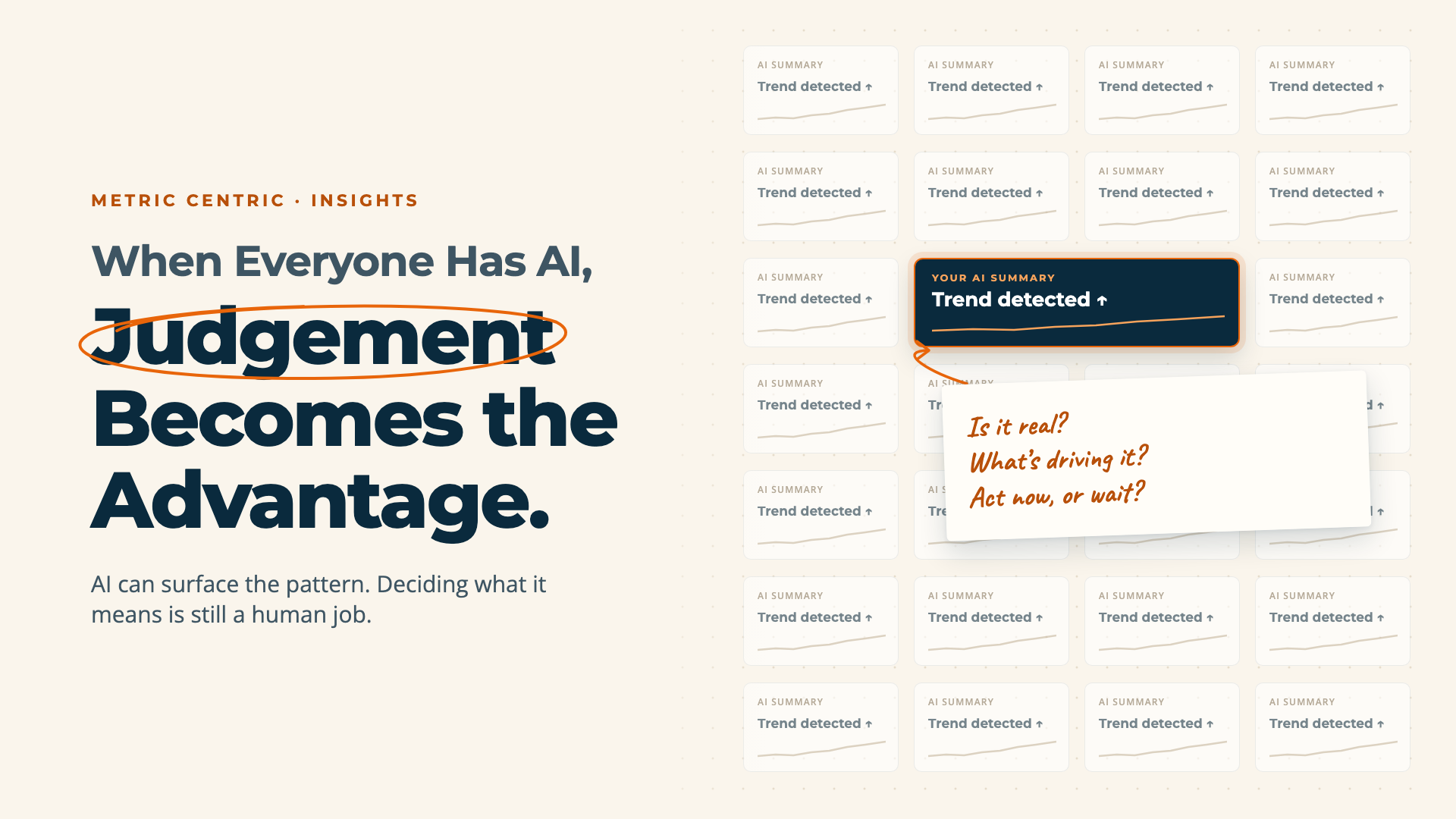
The AI report makes the problem visible. But it doesn’t necessarily tell the company what to do.
An experienced analyst might notice that many complaints began following a recent software update. What initially looked like isolated customer frustrations could point to a more widespread technical issue.
But that interpretation still needs to be tested. Are certain camera models more affected than others? Did the software update cause the problem? Is the issue widespread enough to affect customer retention, or is a small group of vocal users driving the conversation?
AI can surface the pattern and suggest possible explanations. The analyst’s responsibility is to examine the evidence, challenge those explanations, identify what’s missing, and determine whether the findings are strong enough to justify action.
That distinction matters. Acting too quickly could divert resources from other priorities. Waiting too long could turn a relatively small technical issue into a much larger customer satisfaction problem.
For decades, access to information and sophisticated analysis gave organizations an advantage. Those with the largest research teams, deepest datasets, and most advanced analytical tools could see things others couldn’t.
Artificial intelligence is fundamentally changing that equation.
Today, almost anyone can summarize thousands of customer comments, analyze business activity, identify emerging trends, or generate a market assessment in seconds.
When analysis becomes abundant, something else becomes increasingly valuable: human judgement.
What the Dashboard – and AI – Might Be Missing
AI is extraordinarily capable of identifying patterns, organizing information, and connecting seemingly unrelated data points. What once required days of research can now be accomplished in minutes.
But identifying a pattern isn’t the same as understanding its significance.
Consider how this applies to understanding a brand’s presence online. A company might have strong visibility in AI-generated recommendations while customers express growing dissatisfaction in online communities. Conversely, it might earn enthusiastic customer reviews yet remain largely absent from AI-generated answers.
Neither finding tells the complete story.
A company discovering that its products rarely appear in AI-generated recommendations might assume it needs to invest more heavily in Answer Engine Optimization (AEO). But before making that decision, it needs to understand why that visibility is limited. Are AI platforms drawing on a narrow range of sources about the brand? Is the company missing from relevant industry discussions? Or is the visibility gap limited to certain types of questions?
The answers matter because they determine what the company should do next.
This is the broader challenge facing organizations as AI becomes embedded in business intelligence. The quality of an answer depends not only on the information available, but also on the question being asked, the context provided, and the assumptions behind it.
Ask an AI platform which company leads an industry, and you’ll likely receive a confident answer. But does leadership mean revenue, market share, customer satisfaction, brand reputation, or something else entirely?
An answer can be technically accurate and still fail to address the business question that matters.
In our previous article, The Signals Your Dashboard Can’t See, we explored how traditional business intelligence often overlooks valuable information hidden within unstructured conversations. That challenge becomes even more relevant as organizations increasingly rely on AI-generated analysis.
There are two complementary perspectives worth examining: what people are saying across the open web and what AI answer engines are saying about brands, industries, and competitors.
AI can help organizations examine both at an extraordinary scale. But experienced analysts still need to evaluate the sources, challenge the conclusions, and determine what the findings mean within the broader business context.
The goal isn’t simply to collect more information. It’s to understand what deserves attention and why.
The Value of Human Judgement
As AI capabilities become more accessible, organizations will increasingly have access to similar analytical tools. But having access to the same information doesn’t mean they’ll interpret it the same way.
Some will accept the first plausible answer. Others will challenge assumptions, connect information from different sources, and ask whether the evidence supports the conclusion.
The organizations that benefit most from AI won’t necessarily be those generating the greatest number of reports, dashboards, or automated insights. They’ll be those that know which findings deserve attention, which assumptions require scrutiny, and which issues warrant action.
Technology can dramatically accelerate discovery. But leaders still have to decide what those findings mean, how much confidence to place in them, and what to do next.
As machines become better at analysis, human curiosity, experience, and judgement remain essential to making better business decisions.
Ultimately, the question isn’t how much information AI can give us. It’s whether we’re asking the right questions – and whether we know what to do with the answers.
The New Intelligence Gap is a series from Metric Centric exploring why access to more data and increasingly powerful AI doesn’t automatically produce better business intelligence – and what organizations can do to close that gap.
At Metric Centric, we combine conversational data analytics, competitive intelligence, and Answer Engine Optimization (AEO) visibility analysis with experienced human interpretation. Our goal is to help organizations move beyond simply collecting data to understand what matters and why. If you’re interested in understanding what your markets are saying – and what AI is telling your audiences – let’s start a conversation.