
Contributing Author:
George Assimakopoulos – Managing Principal @ Metric Centric
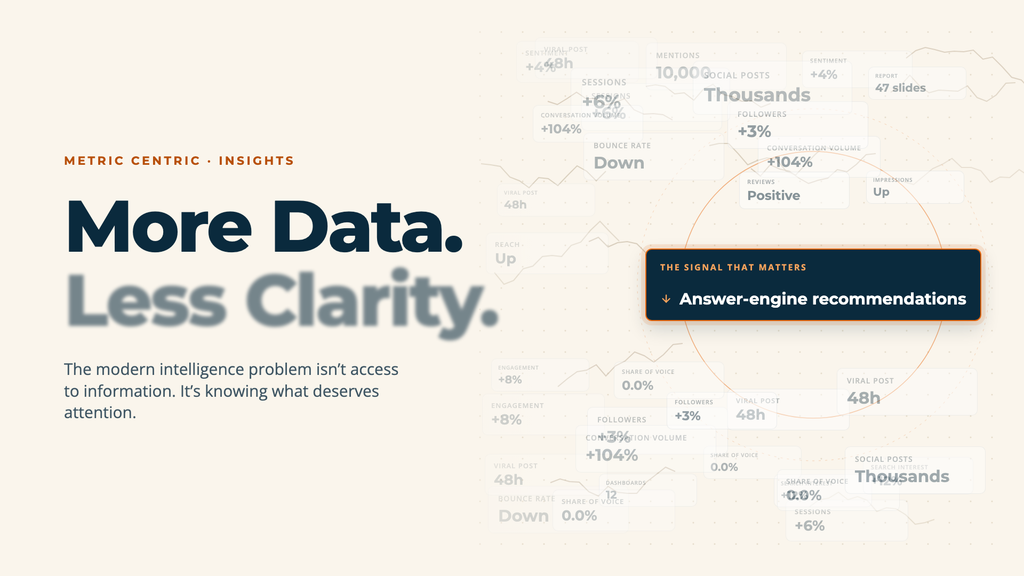
At 8:47 on a Monday morning, a marketing executive opens her laptop and starts clicking through dashboards.
- Customer sentiment is up 4%
- Search interest is up 12%
- Engagement is up 8%
- Share of voice hasn’t moved
- A new product has generated thousands of social conversations
- Customer reviews are still overwhelmingly positive
- And the company’s AI monitoring platform has flagged a decline in the number of times the company is being recommended by answer engines
There is more information on the screen than any executive could reasonably process before lunch.
So, she asks the question: What should I care about?
That question increasingly defines the modern business intelligence problem.
For the past two decades, organizations have invested billions of dollars solving for one thing: More data.
More customer data. More social data. More search data. More behavioral data. More competitive data. More dashboards. More platforms. More metrics.
And now AI is making all of it dramatically easier to access.
Ask a question. Get an answer. Summarize 10,000 conversations. Analyze a year of customer feedback. Compare five competitors. Find the patterns. Generate the report.
All in seconds.
It sounds like the ultimate solution to information overload.
But it may actually make the problem harder.
AI is making information cheaper at exactly the moment attention is becoming more expensive.
That changes the business intelligence equation entirely.
We don’t have a data problem anymore
Imagine a company notices that customer conversations about one of its products have doubled in a month.
A traditional analytics system might celebrate the discovery. The dashboard turns green. The report says, “Conversation volume increased 104%.” An AI system might go further. It can categorize the conversations, analyze sentiment, identify themes and produce a summary before the morning meeting is over.
But then someone asks a more important question: Why did conversations double?
Maybe customers suddenly love the product. Maybe a celebrity mentioned it. Maybe a competitor launched a campaign attacking it. Maybe customers discovered a frustrating defect. Maybe 90% of the new conversations came from a single viral post that will disappear in 48 hours.
The metric is real in every scenario. Its meaning is completely different.
That distinction is becoming more important as organizations accumulate more information.
Most companies don’t have a shortage of data anymore. They have a shortage of clarity.
They don’t need another dashboard telling them what happened. They need to know:
- What changed?
- Why did it change?
- Does it matter?
- What should we do about it?
Those are very different questions.
And yet much of the business intelligence industry remains focused on data collection and measurement.
Track everything. Measure everything. Visualize everything. Report everything. Then, hand leadership 47 slides and call it insight.
It isn’t.
Data becomes intelligence only when it changes how someone understands a problem or makes a decision.
Everything else is information.
More measurement can actually create less clarity
Consider what happens when several different systems are looking at the same market:
- One says conversation volume is rising.
- Another says sentiment is declining.
- A third says engagement is improving.
- A fourth says share of voice is flat.
- Search interest is increasing.
- Competitor visibility is rising.
- Customer reviews remain positive.
- And an AI monitoring platform says the company is appearing less frequently in answers about its own category.
None of these signals necessarily contradict one another.
But they create a new challenge: Determining which one deserves attention.
The temptation is often to add another metric. Or another dashboard. Or another AI-generated summary.
But eventually, the organization isn’t suffering from a lack of intelligence. It’s suffering from an inability to prioritize evidence.
That is a very different problem.
The next competitive advantage is signal detection
The most valuable intelligence systems of the next decade won’t necessarily be the ones that collect the most information.
It may be the one that knows when something is different.
- What suddenly changed?
- What is accelerating?
- What is appearing across multiple sources?
- What contradicts what we thought we knew?
- What are customers beginning to ask that they weren’t asking six months ago?
- What competitor is becoming associated with a topic we historically owned?
- What seemingly small conversation today could become a significant market issue tomorrow?
Those are signals – and signals are fundamentally different from metrics.
A metric tells you something happened. A signal suggests something may be changing.
The distinction matters because markets rarely announce major changes all at once. They whisper first.
A handful of unusual customer questions. A competitor suddenly talking about a topic it previously ignored. A small but persistent change in search behavior. A new complaint appearing across several seemingly unrelated channels.
One data point isn’t necessarily meaningful. But several weak signals pointing in the same direction might be – and could be where real intelligence comes from.
Stop treating every data point as equally important
There is a strange skill that becomes increasingly valuable as information becomes abundant:
Ignoring things.
A viral complaint isn’t automatically a reputational crisis. A spike in mentions isn’t automatically momentum. Positive sentiment isn’t automatically brand strength. High engagement isn’t automatically influence. Share of voice isn’t automatically share of mind. And being mentioned by an AI answer engine isn’t automatically authority.
Context determines significance.
A company might receive 50,000 negative social posts because of a joke that went viral.
Another company might receive 500 complaints from a relatively small group of customers – but those complaints could expose a serious product problem.
The first story is louder.
The second might matter more.
It may sound counterintuitive. But in an environment of infinite information, the ability to deliberately disregard weak signals becomes just as important as the ability to discover strong ones.
AI won’t eliminate information overload
There is a popular assumption that AI will solve this problem by summarizing everything for us.
AI will certainly make analysis faster. It will process more information than any human team ever could. It will identify patterns we might otherwise miss.
But it will also make it dramatically easier to create more reports, more summaries, more recommendations and more “insights.”
In other words, AI may reduce the cost of analysis while simultaneously increasing the supply of things demanding our attention.
That means the scarce resource isn’t computing power. It isn’t data. It isn’t even analysis.
It’s judgment.
Human judgment may become more valuable because of AI. This is one of the enigmas of the AI era. As machines become better at analyzing information, experienced human judgment may become more important – not less.
Someone still needs to ask:
- Is this meaningful?
- Is this credible?
- Is this unusual?
- Is this connected to something else we’re seeing?
- Does this challenge our assumptions?
- Should leadership care?
AI can help find patterns. But deciding which patterns deserve organizational attention requires context, experience and judgment. That’s the difference between processing information and understanding a market.
There is now another intelligence layer
The situation becomes even more interesting as answer engines become part of how people research markets, products and companies.
For years, organizations monitored what customers, journalists, analysts and competitors said about them.
Now they also need to understand:
- What does AI believe about us?
- What do answer engines say when someone asks about our category?
- Which competitors appear?
- Which companies are recommended?
- Which sources are cited?
- Which attributes are associated with our brand?
- Which topics are we absent from entirely?
That creates a fascinating new feedback loop. The market produces information. The web records it. AI systems interpret it. Answer engines synthesize it. And those answers increasingly shape what people believe about the market.
Business intelligence can no longer focus exclusively on what people are saying. It must also understand how machines are interpreting what people are saying.
The dashboard was never the destination
For years, the ambition of business intelligence was visibility.
Build the dashboard. Centralize the data. Make everything measurable. Give everyone access.
Those were important advances. But visibility is no longer enough. When everything is visible, prioritization becomes the advantage.
The organizations that outperform won’t necessarily know more than everyone else. They’ll become better at recognizing what matters sooner.
They’ll know which conversations deserve investigation. Which anomalies deserve escalation. Which competitive movements deserve attention. Which customer questions indicate changing expectations. And which answer engine responses reveal gaps in market authority.
Perhaps we need a better test for business intelligence. Not how much did we measure? Not how many sources did we analyze? Not how sophisticated is the dashboard?
But rather: What do we understand now that we didn’t understand before? What decision can we make with greater confidence because of it?
If an intelligence program can’t answer those two questions, the organization may simply be producing more information about its information.
And we already have plenty of that.
The next frontier of business intelligence isn’t bigger data. It isn’t more dashboards. It isn’t even AI.
It’s discernment – the ability to separate signals from noise. To recognize change before it becomes obvious. To connect seemingly unrelated evidence. To know what deserves attention – and what doesn’t.
Because in a world where everyone has access to more information than they could possibly consume, knowing more isn’t the advantage anymore.
Knowing what matters is.