
Conversational Data:
The Missing Feedback Loop
Contributing Author:
George Assimakopoulos – Managing Principal @ Metric Centric
A few weeks ago, I asked a simple question to a room full of smart B2B executives:
“How do you know what people are saying about your brand?”
The answers came quickly – surveys, social listening tools, customer reviews, NPS scores.
All valid. All familiar.
Then, I asked a follow-up:
“How do you know what answer engines are saying about your brand?”
Silence.
That pause is where this story begins.
For years, organizations have invested heavily in understanding human perception. We’ve built entire industries around capturing the voice of the customer – and rightly so.
But something has changed.
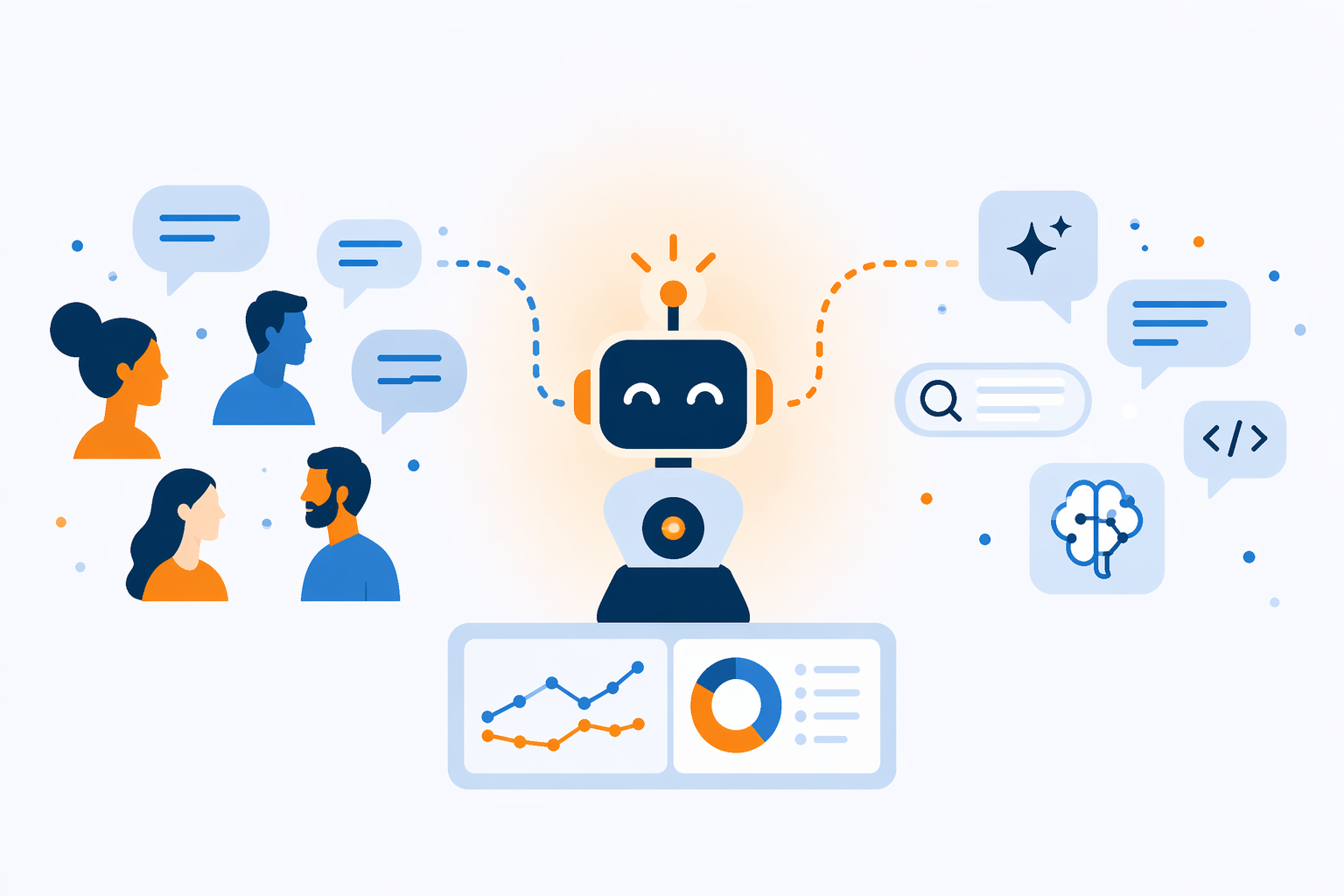
Today, there are two parallel conversations happening about every brand:
- One among people (reviews, social posts, forums, word-of-mouth)
- One among machines (AI-generated answers, summaries, recommendations)
And here’s the catch: most organizations are only listening to one.
The Danger of Optimizing for One Audience
I was working with a B2B client, who had just completed a major brand campaign. Their internal dashboards looked great – engagement was up, sentiment was positive, traffic was climbing.
On paper, everything was working.
Then, we ran a simple test: we asked multiple answer engines a series of questions about their brand and category of products.
The results told a different story.
Competitors were mentioned more prominently. Key differentiators were missing. In some cases, outdated or incomplete information surfaced.
It wasn’t that the campaign failed. It’s that the machines didn’t learn from it. And increasingly, machines are where business decisions begin.
Optimize for only humans, and you may win attention but lose representation in AI-generated answers. Optimize for only machines, and you may gain visibility but risk sounding robotic, disconnected or inauthentic to actual people.
Both paths create blind spots – and those blind spots compound over time.
AI systems don’t just reflect the internet – they interpret it, compress it and present it as truth.
If your brand isn’t:
- Consistently mentioned
- Clearly differentiated
- Associated with the right ideas
Then the “answer layer” of the internet starts forming without you.
The Feedback Loop That Never Closes
Most organizations operate with an incomplete feedback loop:
- Publish content
- Measure human engagement
- Optimize messaging
What’s missing is the second half:
- Observe how AI systems interpret that content
- Understand what they surface and what they ignore
- Adjust accordingly
Without this complete loop, you’re essentially speaking into a system that is learning, but not necessarily learning you.
AI Doesn’t Just Listen. It Decides.
We’ve moved from “find me information” to “tell me what’s true.”
That shift matters because fewer sources now shape more perception.
If your brand isn’t consistently included in those synthesized answers, you’re not just less visible – you’re less remembered.
Humans ask: “What do I think about this brand?”
Machines answer: “What is generally accepted about this brand?”
Those are not the same thing. If you’re not monitoring both, you’re only seeing half the picture.
The future won’t belong to the loudest brands. It will belong to the most accurately represented ones.
The ones that:
- Continuously monitor what people are saying
- Actively evaluate what machines are summarizing
- Align their messaging across both realities
- Treat AI outputs as a new form of perception data, not just a novelty
The Real Question
You probably have a good sense of what people are saying about your brand. But now the more important question is:
Do you know what machines are saying about you – and why?
In a world where answers are increasingly generated, your brand isn’t just what you say it is – it’s what gets repeated.
If you’re not actively monitoring that layer, you’re not just missing insight – you’re leaving your reputation up to interpretation.
Final Thought
Conversational data is no longer just about listening to your audience.
It’s about understanding how your brand is interpreted, learned and retold – by both humans and machines.
That’s the missing feedback loop.
When you can see how those two worlds converge – and where they diverge – you gain something far more valuable than awareness: clarity of representation.
In a landscape where fewer answers shape more perception, that clarity becomes a competitive advantage.
The organizations that figure this out first won’t just be heard. They’ll be accurately remembered, consistently represented and ultimately trusted.
If you’re unsure how your brand is represented across AI answer engines and where those perceptions may be incomplete, outdated or missing altogether – that’s exactly where we can help. At Metric Centric, we analyze both human conversations and AI-generated answers to give you a clear, actionable view of how your brand is understood today and what to do next. Connect with us today – and let’s close the feedback loop and make sure your brand is visible and accurately represented across both people and machines.