
April 12, 2026
Tags
Contributing Author:
Michael B. Snead – Business Advisor @ Metric Centric
You’re planning a quick weekend getaway to Austin with friends from college, and you’re tasked with making the itinerary – the hotel, dinner reservations, the bars that will actually be worth it on a Saturday night.
Normally, that means scrolling travel blogs, comparing prices across five tabs and jumping between booking sites.
But with your schedule, you don’t have time for that, and now, you don’t have to.
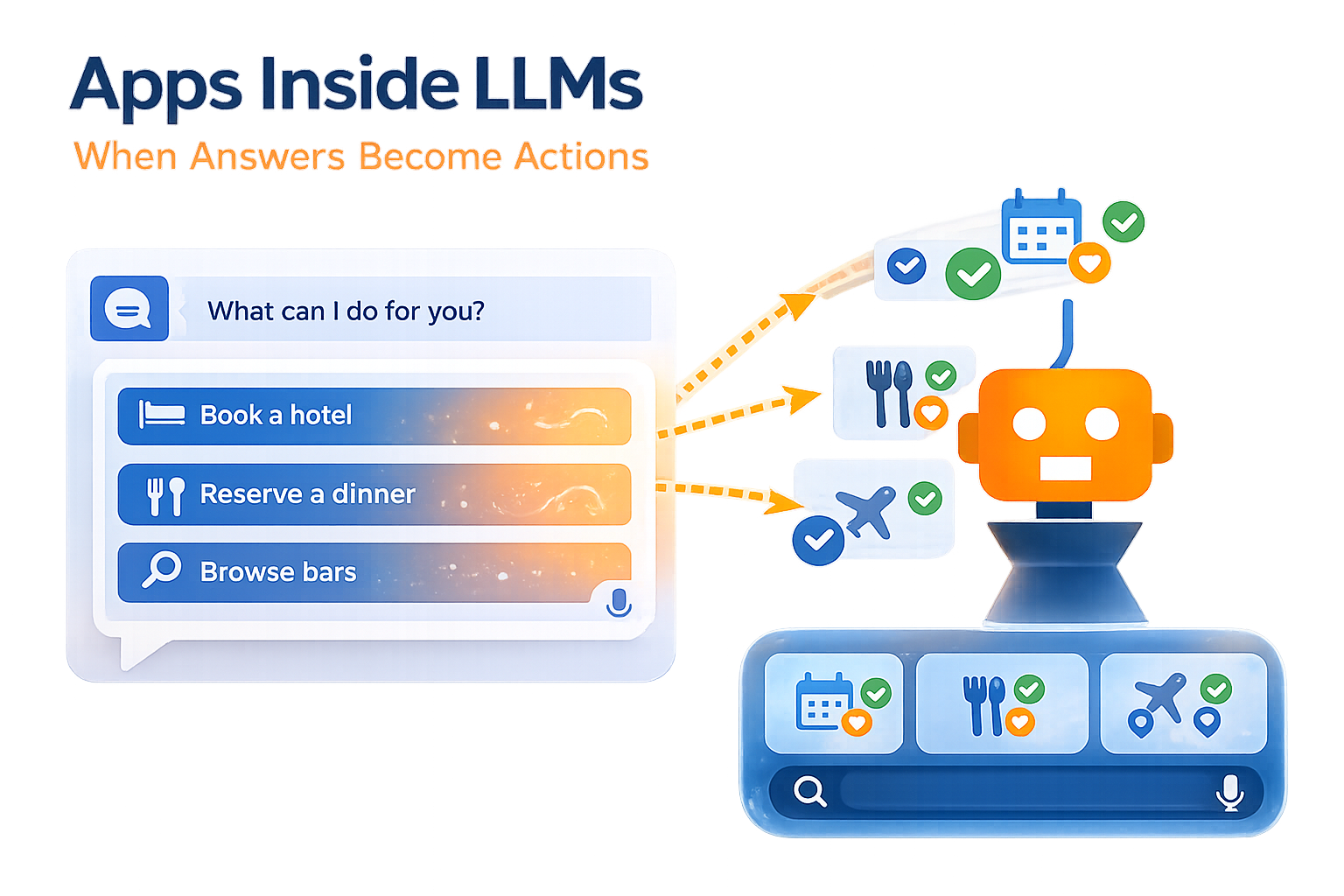
Platforms like Booking.com and Expedia are integrating directly with AI systems like ChatGPT. Instead of searching, clicking and navigating across sites, you can generate and book an entire itinerary in one place – inside the conversation.
For years, digital experiences followed a predictable path.
You searched.
You clicked.
You navigated a website or app.
AI is quietly collapsing those steps.
Large Language Models are no longer just answering questions. They are becoming interfaces that connect directly to tools, platforms and brand systems.
Find a home.
Book a trip.
Design a file.
All without leaving the conversation.
This marks the shift: AI is no longer a destination. It’s a distribution layer.
From Discovery to Action
Zillow, Booking.com, Figma and others are already building agentic experiences – systems where AI doesn’t just inform decisions, but executes them.
Instead of users coming to your website or app, your capabilities are being pulled into AI platforms like ChatGPT or Gemini.
Your product becomes:
- Callable
- Actionable
- Embedded
In this world, brands don’t just appear in results. They show up as options for action.
This changes how customers interact with both AI and brands.
When someone asks an AI to “design a pitch deck” or “order me the best Pad Thai in Cleveland,” the AI isn’t just summarizing information. It is selecting tools, recommending platforms, and in some cases, completing the task.
Relevance is no longer just about being discoverable. It is about being usable.
Why Structure Becomes Strategy
AI agents don’t “browse” the way humans do. They rely on:
- Structured content
- Trusted APIs
- Clearly defined capabilities
They need to understand:
- What your brand does
- What it does best
- When it should be used
If that picture is incomplete or inconsistent, your brand is less likely to be surfaced or selected. This is where search, content and customer engagement converge.
Traditional SEO focused on ranking pages. Answer engine optimization focuses on enabling outcomes. The question shifts from:
“Can we be found?” to “Can we be chosen and used?”
Voice of customer data helps define which actions matter most. Usage data reveals where friction exists. Help content and documentation become the operating manual AI uses to decide when and how to act. Content becomes infrastructure.
Designing for an Agent-Driven World
This shift requires a new mindset.
It is no longer enough to explain what you do. You must define what you enable.
Not just who you are for, but what jobs you help customers accomplish and under what conditions.
The brands that win in this environment will think beyond pages and screens. They will design their content, data and systems to be composable.
Clear inputs. Clear outputs. Clear value.
AI will increasingly be the front door.
Agents will be the concierge.
And brands will be chosen based on trust, clarity and usefulness.
The future of AI search will not be about 10 blue links or even a single answer. It will be about which brands are invited into the workflow.
Visibility will matter. Actionability will matter more.
And the brands that prepare now will not just be found. They will be used.
Want to understand the voice of your customer and learn about the actions that matter most to them? We help to uncover exactly that at Metric Centric. Let’s make sure your content is visible to both people and answer engines. Reach out to us at Metric Centric – and let’s talk.