
Contributing Author:
George Assimakopoulos – Managing Principal @ Metric Centric
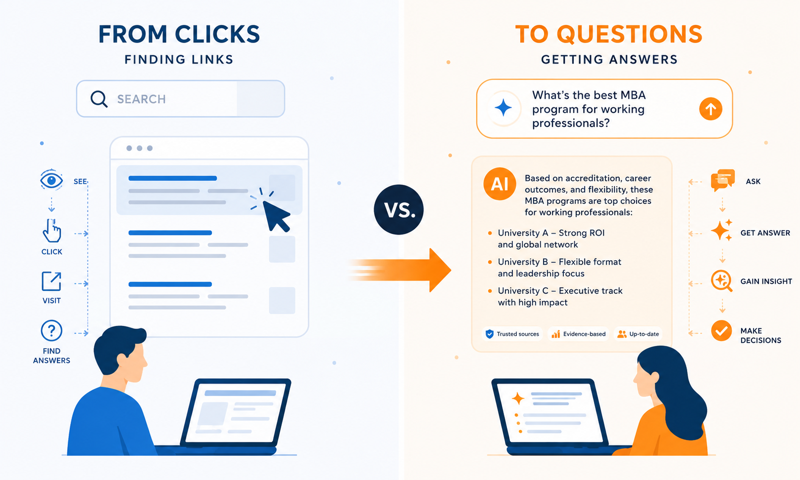
For more than two decades, digital strategy revolved around a simple premise: Get clicks.
Clicks became the currency for attention. Attention became the currency for influence. And influence became the currency for business value.
Entire industries were built around optimizing this model. SEO teams chased rankings. Publishers chased impressions. Brands chased traffic. Media buyers chased engagement rates.
Everyone competed to intercept a human being before they made a decision.
But AI answer engines are changing the sequence entirely.
Today, people increasingly begin with a question – not a search.
And instead of returning a list of links, systems like OpenAI, Google, Perplexity AI and Anthropic increasingly attempt to deliver the answer themselves.
That subtle shift changes everything.
The value is no longer in attracting the click. The value is in becoming the understanding that shapes the answer.
Brands that understand this new reality are the ones that will win in the answer-engine era – and shape user decisions without ever needing a click.
The Death of the Click as a Signal
Historically, clicks told us something important:
- What captured attention
- What users found relevant
- What content “won” the search result
- Which brands successfully interrupted intent
But clicks are now becoming a weaker signal of influence because many user journeys no longer require them.
Today, a user asks:
- “What’s the best MBA program for working professionals?”
- “Which cybersecurity vendors are trusted by enterprises?”
- “What nursing schools have the strongest clinical reputation?”
- “What fuel providers are most reliable in business aviation?”
- “What’s the difference between hydrogen electrolyzers and fuel cells?”
Large Language Models (LLMs) respond with synthesized understanding before the user ever visits a website. The click used to represent discovery. Now, the answer itself becomes the discovery layer.
That means organizations must rethink what visibility actually means.
Because if your brand is absent from the answer – or represented incorrectly inside it – the traditional metrics downstream become irrelevant.
LLMs Optimize for Resolution, Not Navigation
Many organizations still misunderstand this shift.
Search engines historically optimized for navigation:
“Here are links that may help you.”
Answer engines optimize for resolution:
“This is likely the most useful understanding.”
That distinction matters enormously.
LLMs are not primarily trying to send users elsewhere. They are trying to reduce uncertainty.
This means the winning organizations will not simply be:
- Loudest
- Most promotional
- Most keyword-dense
- Ones generating the most content
Instead, the winners will be the organizations that become:
- Understandable
- Structurally extractable
- Consistently referenced
- Contextually reinforced
- Trusted within machine-readable ecosystems
In other words – AI systems reward clarity over noise.
The New Battleground: Trusted Understanding
For years, organizations fought for visibility. Now they must compete for trusted understanding.
That is a fundamentally different objective.
Visibility asks: “Can I be seen?”
Trusted understanding asks: “When the machine synthesizes knowledge, how does it describe me?”
Most organizations still optimize for:
- Campaigns
- Traffic spikes
- CTRs
- Impression volumes
- Funnel mechanics
Meanwhile, LLMs are forming probabilistic representations from:
- Repetition
- Authority
- Structured consistency
- Cross-source corroboration
- Citation ecosystems
- Conversational reinforcement
- Extractable explanations
The implication is significant.
Your website is no longer your brand’s sole source of truth. An answer engine’s understanding of your organization becomes the operational truth influencing buyers, students, patients, investors, partners and stakeholders.
Influence Is Moving Upstream
In the traditional web model, users:
- Searched
- Clicked
- Evaluated
- Formed opinions
In the answer-engine model:
- Users ask
- AI synthesizes
- Understanding is pre-shaped
- Users evaluate from an already-influenced position
This means influence is moving upstream into the answer formation layer itself.
Organizations now need to ask new questions:
- How are AI systems describing us?
- What themes are consistently associated with our brand?
- What context gets amplified?
- What nuance gets erased?
- Which competitors are more structurally understandable than we are?
- What authoritative sources reinforce our positioning?
- Are we cited – or merely present?
These are no longer theoretical questions. They are operational business questions.
Why “Authority” Alone Is No Longer Enough
Historically, strong domain authority could compensate for weak clarity. That is changing.
AI systems increasingly depend on:
- Extractability
- Semantic clarity
- Reinforced consensus
- Structured explanation
- Topic association consistency
An organization may be highly respected in the real world, yet poorly represented inside LLMs because its expertise is:
- Buried in PDFs
- Inconsistently explained
- Hidden behind marketing language
- Poorly structured
- Weakly corroborated externally
This creates a new strategic risk: Invisible expertise.
And invisible expertise loses influence in AI-mediated environments.
The Shift from SEO to Representation Strategy
Let’s be very clear: SEO is not dead. But SEO alone is insufficient.
Organizations must now think beyond rankings and toward representation strategy.
That means optimizing for:
- How AI systems learn
- How they retrieve
- How they summarize
- How they compare
- How they cite
- How they infer trust
The future leaders will not merely “rank.” They will become:
- Referenceable
- Explainable
- Repeated
- Structurally memorable
Because AI systems do not remember brands the way humans do. They remember patterns.
Actionability Becomes the New Conversion Layer
The next shift may be even more important.
Answer engines are rapidly moving from providing answers to driving actions.
This means AI systems will increasingly influence:
- Vendor shortlists
- School consideration
- Product comparisons
- Travel decisions
- Healthcare choices
- B2B evaluations
- Media discovery
- Procurement pathways
The answer itself becomes a recommendation layer. Organizations must now optimize not only for understanding, but for actionability, too.
Can the AI system confidently:
- Recommend you?
- Explain your differentiation?
- Associate you with leadership?
- Position you within the right category?
- Surface supporting evidence?
- Connect your expertise to user intent?
This will be the new conversion environment for KPIs.
The Organizations That Will Win
The organizations that thrive in the answer-engine era will understand a critical truth: The goal is no longer to generate traffic. The goal is to establish trusted machine-facilitated representation.
That requires:
- Clear articulation of expertise
- Reinforced topical authority
- Structured and extractable content
- External validation
- Consistent contextual signals
- Conversational relevance
- Citation alignment
- Cross-platform reinforcement
Organizations must optimize not simply to be found – but to be faithfully understood.
Because in the age of AI answer engines, understanding becomes influence – and influence increasingly shapes decision-making before a click ever occurs.
If you’re wondering how AI answer engines understand and represent your brand today – that’s exactly what we help uncover at Metric Centric. Connect with us today – let’s make sure your business is visible to both people and machines.